
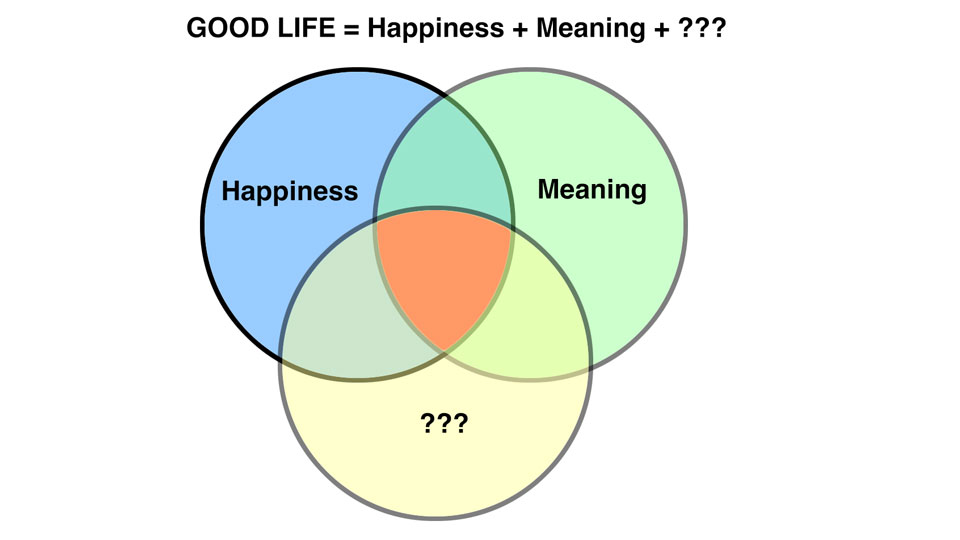
So, well-being – beyond a feeling of happiness and a sense of meaning – is more than an end state. It’s something that remains dynamic, something contrary to complacency. It’s an ongoing state of engagement, of paying attention.
A key aspect of well-being is a perspective, a skillset which deals with the ongoing hard times in life without lapsing into despair. A balance.
This Big Think article addresses this ongoing dynamic, and why chasing happiness directly – as if seeking a magic fountain of joy – can be counterproductive.
The work of well-being (in a world of worries) is to “build a baseline of positivity that actually lasts.” And that is something which Zen addresses, amid the challenges of our attention age.
• Big Think > “3 experts explain how to escape the happiness paradox” by Robert Waldinger MD, Tal Ben-Shahar PhD, and Peter Baumann (Sept 2025) – What if the secret to a happier life wasn’t constant joy, but something far more balanced? [Video 2:57]
We created this video … to help people challenge their perceptions and expand their thinking. Often that growth can start with just a single unlikely question that makes you rethink your convictions and adjust your vantage point.
(from transcript)
TAL BEN-SHAHAR: There is a false understanding that a happy life means being happy all the time. No, it’s not. Learning to accept and even embrace painful emotions is an important part of a happy life.ROBERT WALDINGER: The good life involves a practice of ongoing care for each other, for our relationships, care for ourselves, and it’s a process of continual change.
TAL BEN-SHAHAR: It’s a lifelong journey. So happiness is much more than pleasure. Happiness is whole being.
This second Big Think article is a long-form lecture (video 01:01:37), organized into 5 chapters. It expands on the article above.
• Big Think > “What 85 years of research says is the real key to happiness” with Robert Waldinger (the fourth director of the 85-year Harvard Study of Adult Development) – We never figure it out ultimately, and that that’s perfectly normal. And actually, it’s what makes life rich and interesting.
When we watch these thousands of lives play out over time, what we see is that the good life is an ongoing process, and it’s a process of continual change, which is different from what we all wish for, which is that we would finally get to a place where everything’s good and it’s gonna stay that way.
CHAPTER 1 The 85-year quest to understand happiness
CHAPTER 2 The relationship advantage
CHAPTER 3 Strengthening your connections
CHAPTER 4 Mindfulness, Zen & the good life [@ 29:13]
CHAPTER 5 What to do about loneliness
Chapter 2, The relationship advantage, discusses the essential question, “Do I have what I need?” A Goldilocks zone of connections. And positive emotion regulators.
Chapter 3 discusses social fitness and curated voices. “Paying attention really matters … [and] bringing curiosity to relationships that you might take for granted.”
“And each person can check in with themselves about that.” Which gets us to mindfulness and Zen (Chapter 4). And the “interconnectedness of everything.”
(A corresponding post will focus on mindfulness and Stoicism.)
(excepts)
Zen emphasizes community. It’s called Sangha, in the Buddhist language. And it’s really the idea that we practice learning about ourselves and each other by being in relationships with each other, both during meditation sessions and out there in the world. So, we practice with whatever comes up for us.Well, the main explicit goal of zen is nothing. Zen is a practice. Now, the side effect of practice is waking up. Waking up really means understanding more deeply the truth of what it means to be alive, the truth, for example, that everything is constantly changing, including me, that even the things that look like they are fixed and stable are always in a process of continual change. That’s really helpful because often we try to fix things, we try to hold onto things and make them stay the same, and we suffer a lot when we do that.
It’s often said that the Buddha was teaching that you could get to a point where you never suffer anymore. Zen does not teach that. Zen does not teach that anybody finally arrives at a place where we don’t ever feel pain, where we don’t ever feel worry or unhappiness. Rather, what we can do is learn to be with what’s unsatisfactory in life, learn to be with unhappiness, even be with pain in a way that makes it more bearable, in a way that doesn’t layer on optional suffering.
But zen teaches that unsatisfactoriness is always there in life, and that we do have preferences that we’re never going to completely give up our preferences, but that what we can do is learn to clinging less tightly to our preferences.
In other words, to insist less that the world be a certain way. I mean, think about in relationships how much we try to insist that someone else be a certain way that we want them to be, and how much less we suffer if we let that go. And just assume that that person is allowed to show up in the world as they are, and we are allowed to show up in the world as we are.
So, this idea of relieving suffering is in zen. The idea of being able to face towards suffering, looking at it and living with it in a way that hurts less.
Buddhism talks about the idea of attachment. And it doesn’t mean attachment in the way we normally think of it, like just being connected to somebody or something. It’s really about holding on tightly to a fixed view of something.
So, I’m attached to the idea that there’s one true religion or one true political party, or one true anything.
Shunryu Suzuki was a zen master who had a saying that I love. He said, “In the beginner’s mind, there are many possibilities. In the expert’s mind, there are few.” And what he meant by that is when we can remain open to many possibilities rather than narrowing everything down and being so sure that we know what’s what, that we become open to surprise, open to new ways of experiencing ourselves and the world that make us suffer a great deal less than when we are so-called experts.
And the older I get and the more people call me an expert, the more aware I am of how little I know. Having a beginner’s mind really helps in relationships because it allows us to be curious.
What we teach in zen is … that nobody lives in a kind of unusual altered state all the time. [There’s always the laundry.]
So, although most of us, myself included, wish that there were a way to get enlightened and stay that way, to get to a place where it’s always blissful and we never suffer, I have never met a human being on this earth who gets to that place.
And zen teaching is that that’s not possible. That in fact, we move in and out of states of being more awakened or less awakened. That no matter how evolved you are as a spiritual practitioner, you’re gonna have times when you’re just all upset about stupid stuff, when you’re just deluded, as we say. And then you move back into periods where you see life more clearly.
That’s important for me because if you meet people who hold themselves out as an ultimately enlightened person, be very suspicious of that. Be very suspicious of anybody who claims to be a perfectly evolved, enlightened human being.
And so, the idea of pursuing enlightenment really is not pursuing a self-improvement project. It’s pursuing a way to be as compassionate as I can in each moment, to pursue enlightened activity in as many moments as I can string together in my life.
Striving for enlightenment is a self-improvement project. And what we talk about in my zen tradition is that we don’t want to embark on a self-improvement project. We want to strive for greater kindness and harmony in the world rather than being lost in the delusion of an isolated permanent self. And so, really what we wanna strive for is enlightened activity in the world.
Video transcript [protected page]
“What 85 years of research says is the real key to happiness”
Related articles
[See comments]
“What really makes someone a good person?”
• Big Think > “Is virtue worth pursuing? A psychologist explains” by Sarah Schnitker (August 2025) Video [6:24] – Self-help shortcuts (hacks) miss the mark.
Key points (somewhat paraphrased)
Excerpts from transcript
Does career / work success automatically ensure happiness? Do pay increases have large and long-lasting effects on job satisfaction?
This article (video) explains that: “To get actual happiness from work, you need to seek two things, and really two things only. We call them earned success and service to others.”
• Harvard Business Review > “The Success-Then-Happiness Fallacy” (8-12-2025) [Video 2:47] by Arthur C. Brooks, author of The Happiness Files: Insights on Work and Life – Chasing success has costs that can end up lowering happiness, as many a desiccated, lonely workaholic can tell you. Instead, start focusing on the less visible “happiness metrics” of your work.
Summary
Excerpts from transcript
In the context of seeking success & happiness, here’s another perspective on friction, as an inevitable aspect of life. In this case, a perfectionist mindset vs. “getting real” about:
* Flaws – you’re continually “bugged” because not everything (or every experience) is perfectly to your liking or expectation.
* Shelf life – your wonderful (or at least good enough) sweet-spot (or spotless space, eh) of familiarity and meaning is challenged by change – doesn’t last forever.
* Summiting – your quest for a final state (or place) of ascendency (or validation) is a letdown – an unsatisfying “false peak.”
The wellness of the world within and without is an ongoing journey – a process, not a perfected place (or perfected recipe). Not a permanent state. Not a completed trek.
This article includes some tips on practicing Wabi-Sabi [1] in daily life.
• Psychology Today > Why Wabi-Sabi Is the Best Philosophy of Life by Mark Travers Ph.D., reviewed by Lybi Ma (December 24, 2025) – A Japanese philosophy that helps us see life’s imperfections as irreplaceable.
Summary points (quoted)
Notes
[1] Wiki > Wabi-sabi