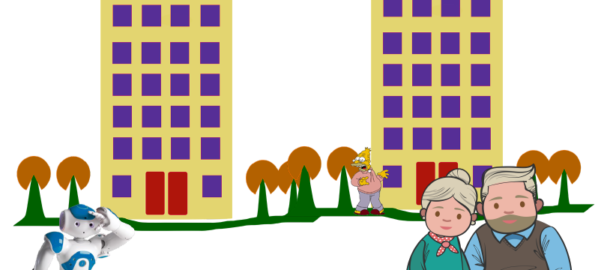
If we build them, will they be accepted? The Simpsons S31:E12 does not satirize issues about privacy and personal information – just butt wiping. [1] Might co-design and co-production of care robots improve acceptance? [2]
The crew
A team of international researchers, a model of robot acceptance, a small cross-sectional study across Japan, Ireland, and Finland.
The challenge
“Although care robots are being developed and improved at a rapid pace, their social acceptance has been limited.”
Contention arises easily from personality conflict. Sometimes such conflict is framed as that between different values. Yet, what strikes me more & more is that the problem is not unalike values, but that those values are applied only to one’s tribe. As noted in this article, “small tent” value systems – people loyal to their tribe, “and very unloyal to other tribes.”
In his latest Plaintext newsletter, Steven Levy recounts his conversation earlier this summer with legendary artificial intelligence researcher Geoffrey Hinton, “after he [Hinton] had some time to reflect on his post-Google life and mission” – in his “new career as a philosopher.”
• Scientific American > “Are You a Lucid Dreamer?” by Gary Stix, Jeffery DelViscio (July 24, 2023) – An interview with sleep expert Isabelle Arnulf, head of the Sleep Disorders Clinic, Pitié Salpêtrière University Hospital, Paris.
In a milieu of polarization, an era of claims to supremacy – “and nobody’s right if everybody’s wrong” – perhaps complexity can moderate pride. Complexity that resonates like a prayer.
There’s the wider stage of complexity – from the atomic to the cosmic scale. Ecosystems. Culture. But there’s the complexity right in our skulls. Our brain.
• Dictionary.com > Humbling > “causing a person to feel less proud, especially through awe, admiration, or gratitude.”
The mystery of the brain – our sense of identity, our feeling of agency
PFAS chemicals are characterized by a carbon-fluorine backbone (the “F-C” in “forever chemicals”) – the carbon-fluorine bond is one of the strongest bonds in organic chemistry.
The incredible complexity of our global ecosystem … at so many levels …
Here’s one of many articles in the news cycle this week prompted by a recent study from the United States Geological Survey (USGS) – which “analyzed water collected from over 700 taps and kitchen faucets in homes, offices and schools across the country.”
these beasts at the end of my desk, these gerbils, my living phylacteries, busy themselves in front of me, as if to say, “what is there more than eat, work, sleep, and sex? what is this talk of symbols in decay?”
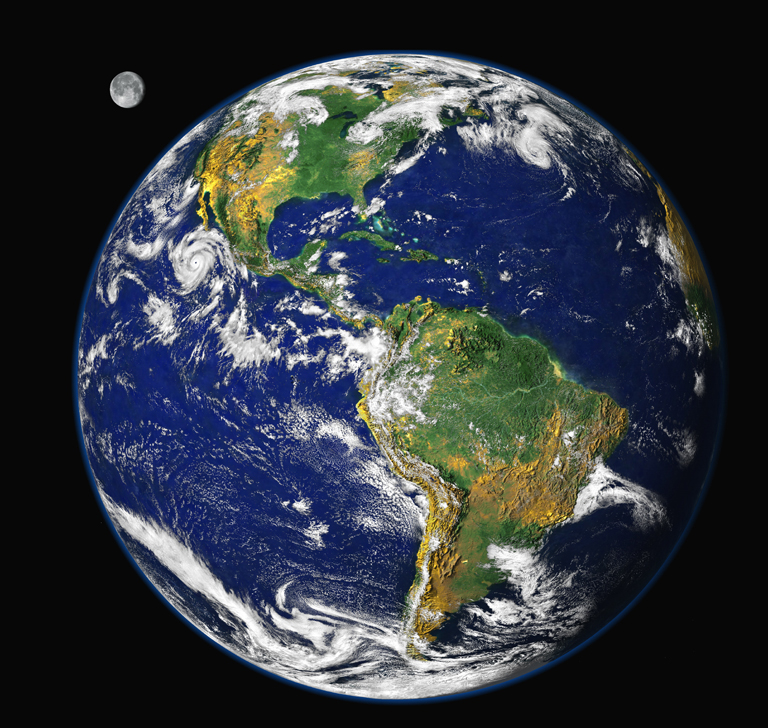
Can space travel – at least orbiting the Earth – cause cognitive shifts? Really be transformative – have lasting impact? [1]
Generally, studies note variability in the experience. And not all astronauts experience the overview effect.
(Wiki) Author [“space philosopher”] Frank White, who in the 1980s coined the term overview effect after interviewing many astronauts, …
Yaden et al. observed that cultural differences, including differences in religious and social identity, affect the ways in which the effect is experienced and interpreted. Expressions range from the religious, to the “vaguely spiritual”, to the naturalistic, to calls to social duty.
Wiki even notes that there’s some research on whether immersive virtual reality simulations might “induce the overview effect in earthbound participants.”
This Big Think article is a personal perspective by astronaut Ron Garan.